
Mel Neil has spent more than 20 years teaching emotional intelligence (EI) to leaders, teams and individuals across healthcare, education, construction, community services and beyond. She knows the research. She knows what works. And she knows, better than most, why emotional intelligence matters and where the field has been getting it wrong.
The Institute of EI is Australia’s dedicated emotional intelligence education institution, and her answer to that. We sat down with Mel to find out what she believes the market has been missing, what drove her to build it, and what she hopes changes for the people who come through the Institute.
Burnout is not a wellbeing campaign
Australian organisations are spending money on wellbeing, but employees are not always experiencing a coherent strategy.
In a 2026 Allianz/YouGov survey, 74% of employees believed their organisation did not have a clear strategy to reduce workplace burnout. The same research estimated substantial planned organisational spending on workplace wellbeing and culture (Allianz Australia).
The problem may not be effort. It may be architecture.
When disconnected initiatives sit outside the way work is designed, prioritised and supervised, employees receive support for the consequences while remaining exposed to the cause.
Start with the duty: workplace burnout prevention
Two people may work late on the same project. One is absorbed, choosing the effort and able to stop afterwards. The other feels Under Australian WHS laws, a person conducting a business or undertaking must eliminate or minimise psychosocial risks so far as is reasonably practicable (Safe Work Australia). Relevant hazards include high job demands, low job control, poor support, lack of role clarity, poor organisational change management, inadequate reward and recognition, poor organisational justice, bullying, harassment and poor workplace relationships (Safe Work Australia).
In Victoria, the Occupational Health and Safety (Psychological Health) Regulations and compliance code have been in effect since 1 December 2025 (WorkSafe Victoria). Employers must identify hazards, control risks, review and revise controls, and consult employees so far as is reasonably practicable (WorkSafe Victoria).
An individual burnout course may support one or more controls. It cannot substitute for this risk-management cycle..

The claims tail is already visible
Safe Work Australia recorded 17,600 serious claims for mental health conditions in 2023–24p, representing 12% of serious claims. Over the preceding decade, these claims rose 161.1%. The median time lost was 35.7 working weeks, almost five times the median across all serious claims, and median compensation was $67,400, more than four times the all-claims figure (Safe Work Australia).
These figures do not measure burnout alone. They demonstrate the wider psychological health exposure within which burnout conversations occur. They also show why prevention cannot be reduced to engagement content.
Individual programmes still matter
Rejecting individual-only solutions does not require rejecting individual capability.
Employees need the language and confidence to describe what is happening. They benefit from recognising cognitive, emotional and physical warning signs before function deteriorates. They may need recovery practices, help-seeking pathways and structured support to return safely.
The evidence suggests those supports work better when organisational conditions change too. In one meta-analysis, organisational-only interventions produced an effect of (d=-0.25) on exhaustion, compared with (d=-0.54) for combined organisational and individual approaches. Participatory change with individual support produced (d=-0.65), although evidence certainty was very low (systematic review and meta-analysis).
This provides a practical design rule:
Never commission an individual burnout programme without naming the organisational control process that will sit beside it.
A five-part programme architecture
Identify: gather data on demands, control, support, clarity, behaviour, justice and change. Use employee experience, not only absence and claims data.
Consult: involve workers and health and safety representatives in interpreting the risks and designing controls.
Control: remove or reduce hazards through work design, staffing, prioritisation, role clarity, manager authority and behaviour standards.
Build capability: train managers and employees in recognition, response, communication, recovery and referral.
Review: test whether exposure and outcomes have changed. Do not treat attendance or satisfaction as evidence of risk reduction.
Measure the right things
Useful measures include:
- exposure to identified psychosocial hazards;
- whether employees can stop or de-prioritise work;
- perceived management support;
- ability to take leave without work intrusion;
- psychological safety in capacity conversations;
- uptake and quality of consultation;
- changes to work following employee feedback;
- recurrence after return to work;
- leading indicators such as overtime, work accumulation and vacancy load.
Questionnaires can support understanding, but should not be treated as diagnosis. Research comparing the Sydney Burnout Measure with depression found poor differentiation in total scores and noted that many symptoms were not specific to burnout (Tavella and colleagues).
The organisational test
Before launching a programme, ask:
Could the organisation point to this training as proof that it has addressed burnout while changing nothing about the work?
If the answer is yes, the programme design is incomplete.
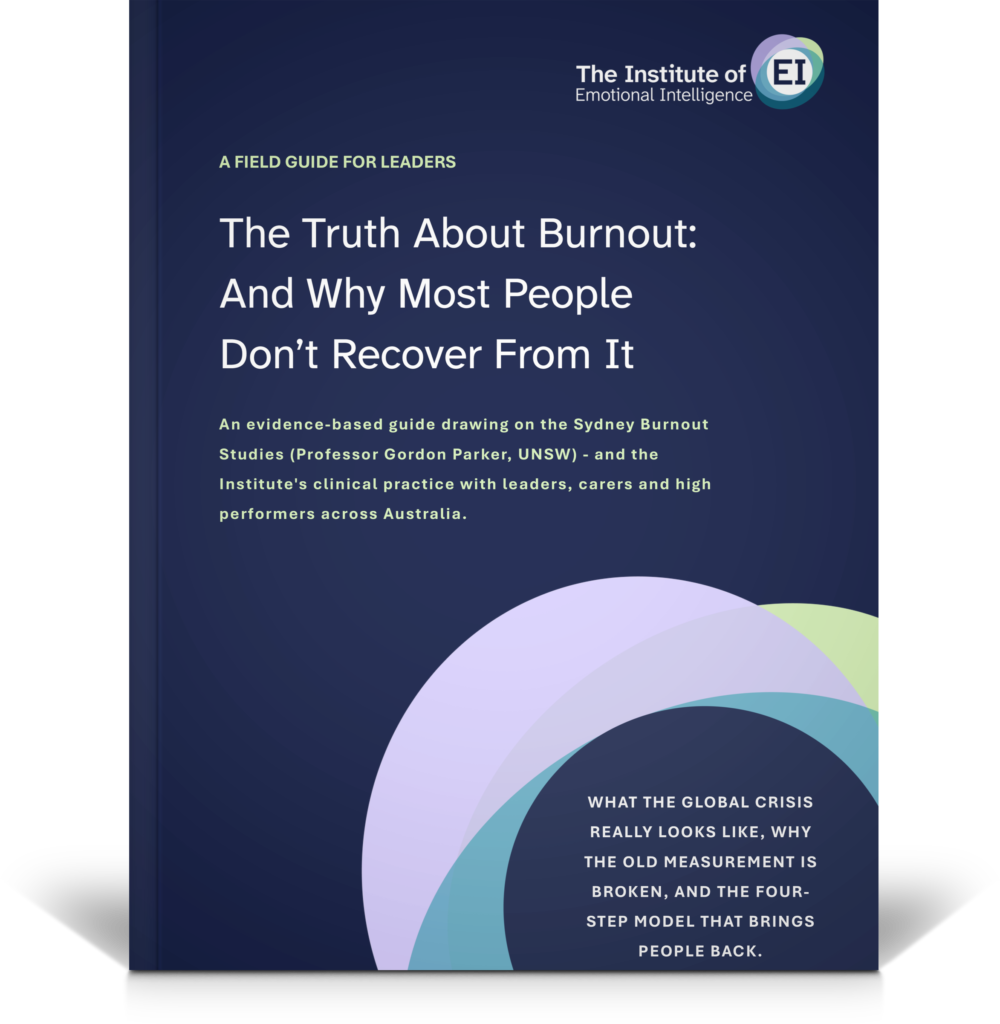
Download The Truth About Burnout as a discussion resource, then use the organisational activation guide to pair employee capability with hazard identification, consultation and documented controls. Contact The Institute of EI to design a combined programme.