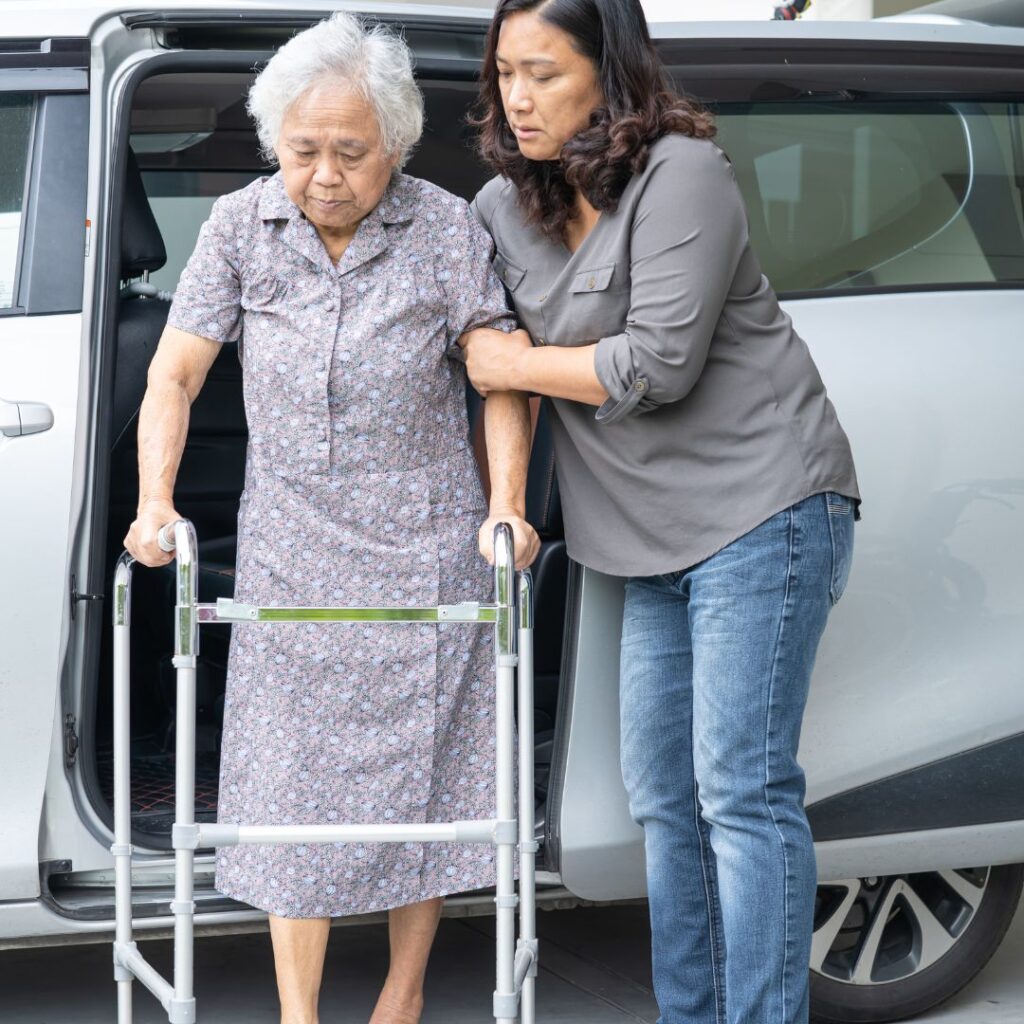
Three million Australians are propping up our health and aged care systems for free. We have decided not to look at what it costs them.
In August, the ABC ran a story about the sandwich generation, a “silent army of more than 1.5 million Australians” caring for ageing parents while raising children and holding down jobs. One woman in that piece, Gohar Yazdabadi, said something that should stop every policymaker, employer and health professional in this country cold:
“They have a term for our condition — carer stress. But there’s no pill for it.”
She is right. There is no pill. But there is a body of evidence, a set of learnable skills, and a very clear choice in front of us. That is where the hope lives, and I will get to it. First we need to be honest about the size of what we are ignoring.
The Hidden Workforce
Australia’s largest care provider does not appear on any payroll
There were three million unpaid carers in Australia at the last count — 11.9% of us, up from 10.8% four years earlier, including 391,300 carers under the age of 25.
Deloitte Access Economics put the replacement cost of that care at $77.9 billion in 2020. Carers Australia now estimates the cost of replacing that care today at $110 billion a year—equivalent to 98% of the Federal Government’s entire health investment in 2024–25.
Read that again. If every unpaid carer in this country stopped tomorrow, replacing them would cost roughly as much as we spend on the entire health system.
This is not a welfare story. It is an infrastructure story. And the infrastructure is showing stress fractures.
What the data actually says
The people holding the system up are the least well people in it
The 2025 Carer Wellbeing Survey – nearly 11,000 responses, run by the University of Canberra with Carers Australia – is not comfortable reading:
· 38.9% of carers had healthy levels of personal wellbeing, against 66.4% of Australian adults.
· 35.9% reported high psychological distress, against 16.3% of the general population.
· 42.7% were often or always lonely. For other Australian adults, it is 11.9%.
· 15.3% rated their general health as very good or excellent. For other adults, it is 43.8%.
· 62.6% had experienced at least one significant financial stress event in the past year.
Carers’ general health has been declining steadily since 2021, and the gap between carers and everyone else is widening.
Separate research cited by the ABC found nine in ten carers have experienced burnout, with nearly half reporting emotional and physical exhaustion, sleep problems and financial stress.
A read of the data: we have built a care economy on the goodwill of people whose own health is collapsing, and we have no plan for what happens when they stop.
We have been calling it the wrong thing
Burnout is not a workplace problem. It is a demand-and-recovery problem
Here is where most carer support goes wrong. We treat carer exhaustion as sadness, stress, or “not coping”—a personal shortfall to be met with a cup of tea and a suggestion to practice self-care.
Professor Gordon Parker AO, founder of the Black Dog Institute and Australia’s leading burnout researcher, has spent years arguing that the World Health Organisation’s framing of burnout as a purely occupational phenomenon is too narrow. People in demanding home situations — caring for children, caring for elderly parents, or the sandwich generation doing both — get, in his words, “exactly the same profile when they get burnout, and burnout is not uncommon”.
Two findings from Parker’s Sydney studies matter enormously for carers.
First, burnout is over-represented in dutiful, reliable, caring people. Parker calls it “part of its tragedy that burnout is over-represented in good people.” The very traits that make someone step up to care for a parent, a partner or a child with a disability— conscientiousness, dutifulness, a high internal standard, an unwillingness to hand the job to anyone else—are the traits that predispose them to burnout from doing it.
Second, the defining symptom is not tiredness. It is cognitive. “Cognitive impairment is the most important impact,” Parker says — people cannot take things in, cannot remember what they did take in, withdraw socially, and slide into anxiety and depression. His team’s Sydney Burnout Measure captures that fuller picture: cognitive disturbance, loss of pleasure, social withdrawal, irritability, insomnia and physical symptoms, not just exhaustion and cynicism.
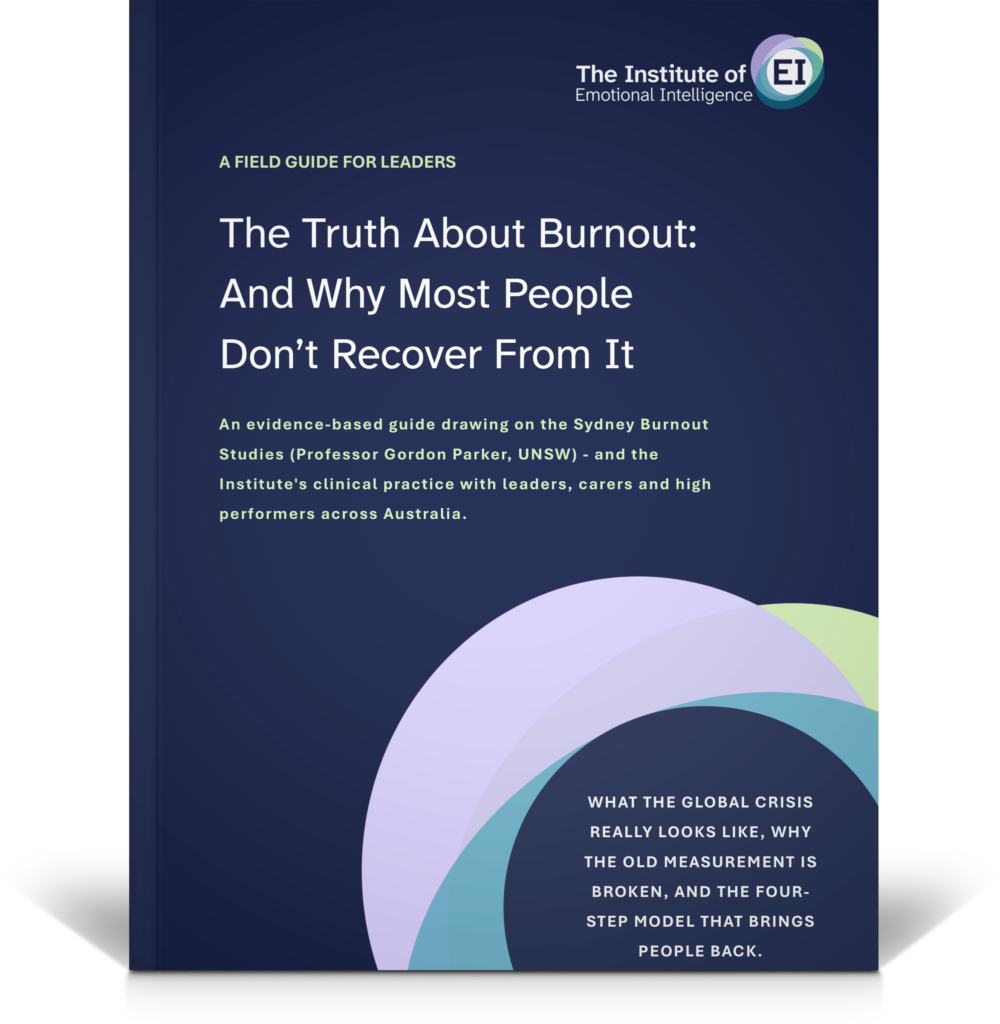
This is why the standard advice fails carers so completely. As we put it in our e-book, The truth about burnout: a break is what you do for tiredness. Burnout is not tiredness. Respite matters enormously — but a fortnight away does not undo the pattern that produced the burnout, and for most carers, the demand is still sitting there when they walk back in the door.
The cost of pretending this is free
Carer burnout is not a private tragedy. It is a public liability
When a carer burns out, four things happen, usually at once.
The care quality drops. Cognitive impairment, irritability and withdrawal are not compatible with managing complex medication regimes, hospital appointments and the emotional needs of a frightened, unwell person.
The system absorbs the cost. A carer who can no longer continue does not end the need for care. They transfer it — to emergency departments, residential aged care, the NDIS, the mental health system. Meanwhile, the ABC reports we need 10,000 additional aged care beds a year and produced 800 last year, with 13 people a day dying before assistance arrives.
The economy loses twice. Carers forgo an estimated $15.2 billion in earnings; women who are primary carers retire with superannuation balances 25–35% lower than non-carers; carers are three times more likely to describe their household as poor or very poor. And 51% of carers say they want to work more. A 5% lift in carer workforce participation is worth around $11 billion to GDP.
A second person becomes unwell. We turn one patient into two.
That is the arithmetic of doing nothing. It is not compassionate to leave carers unsupported. It is not even cheap.
The part that gives me hope
Burnout is preventable, recoverable and – most importantly – learnable
Everything above is grim. Here is what is not.
Burnout is not a character flaw, and it is not a life sentence. It follows a pattern of predisposing, precipitating and perpetuating factors, and every one of those is something you can work on. Recovery is not luck. It is a sequence that can be taught.
That is exactly why I developed our Burnout-to-Balance Masterclass. It works through the Institute’s four-step model:
1. Identify the stressors. Name what is actually happening, using a contemporary measure rather than a guess. Know your symptom pattern, your phase, and your own predisposition.
2. Manage the stressors. Address the person, not just the load — the perfectionism, the over-functioning, the private rule that says rest must be earned.
3. Reduce the trigger points. Find the repeating daily situations that light the fire, and redesign them.
4. Change the system around you. Workload, control, support, recognition, environment. For carers, that means the conversations with siblings, GPs, employers and services that most people never have because they are too depleted to start them.
Why Emotional Intelligence is the foundation
The capability that protects you, and then lets you flourish
Steps two, three and four all require the same underlying capability: emotional intelligence.
Self-awareness is how you notice the drift before the collapse — how you recognise that the numbness and the forgetfulness are data, not weakness. Self-management is how you regulate under sustained pressure without going numb. Social awareness is how you stay connected to the person you are caring for when compassion feels like it is thinning. Relationship management is how you ask for help, negotiate boundaries, and hold a hard conversation with a service provider or a family member without burning the relationship down.
Emotional intelligence is not a soft skill. It is a human capability that can be learned at any age and at any stage.
And here is the part that matters most. EI is protective — but it is not only protective. The same capabilities that keep a carer from burning out are the ones that let them build a life with meaning, connection and energy alongside the caring. Not survival. Flourishing. That is a legitimate thing for a carer to want, and for the rest of us to build for them.
What we owe them
Three million Australians are doing the most important work in the country, unpaid, largely invisible, and increasingly unwell. They are not asking to be called heroes. Recognition alone is cheap, and carers have had a great deal of it.
What they need is targeted, specific support: recognition of caring in workplace policy and public funding, real and accessible respite, and, critically, the skills to identify, manage, recover from and prevent burnout before it takes their health.
We cannot fix the aged care queue this week. We can put evidence-based capability into the hands of the people holding the line.
Burnout is not inevitable. It is preventable, recoverable, and learnable.
If you are caring for someone, or you lead people who are, start with the Burnout to Balance Masterclass. Book a discovery call to bring it into your organisation, or enrol in the next public cohort.
Rise to the challenge – for yourself and those around you.
The Institute of Emotional Intelligence
Human Capability. Elevated.
Sources
· Australian Bureau of Statistics, Disability, Ageing and Carers, Australia: Summary of Findings, 2022 – https://www.abs.gov.au/statistics/health/disability/disability-ageing-and-carers-australia-summary-findings/latest-release
· Carers Australia / University of Canberra, Carer Wellbeing Survey 2025 – https://www.carersaustralia.com.au/wp-content/uploads/2025/10/CWS25_Report_081025_compressed.pdf
· Carers Australia, Economic Reform Roundtable Submission, July 2025 – https://www.carersaustralia.com.au/wp-content/uploads/2025/07/CA_Submission_250725.pdf
· Deloitte Access Economics, The value of informal care in 2020 – https://www.deloitte.com/au/en/services/economics/perspectives/value-of-informal-care-2020.html
· ABC News, Sandwich generation navigating work, elderly parents and kids still at home, 9 August 2026 – https://www.abc.net.au/news/2026-08-09/sandwich-generation-work-elderly-parents-kids-still-at-home/107005466
· ABC News, The definition of burnout needs to change, argues Black Dog Institute founder Gordon Parker – https://www.abc.net.au/news/2023-02-13/gordon-parker-says-the-burnout-definition-needs-to-broaden/101920366
· Parker, G., Tavella, G. & Hopcraft, M. (2023), Exploring the validity of the Sydney Burnout Measure, Psychiatry Research – https://pubmed.ncbi.nlm.nih.gov/37290365/
· Parker, G., Tavella, G. & Eyers, K. (2023), Burnout: A Guide to Identifying Burnout and Pathways to Recovery, Routledge
· The Institute of Emotional Intelligence, The truth about burnout – and why most people never recover from it